
IEC 62443 zones and conduits: definition, model and use with Linux, VMs and Kubernetes
The zones and conduits model was drawn for plants with clear network boundaries. Today a PLC talks to a Linux gateway, the SCADA server is a VM, and dashboards run on Kubernetes. The model still works, but zones have to follow workloads rather than subnets.
Definition. In IEC 62443, a zone is a group of physical or logical assets that share the same security requirements. A conduit is a group of communication channels that connects two or more zones and shares common security requirements. Every flow between zones has to go through a defined conduit, and each zone and conduit gets a target security level from the risk assessment.
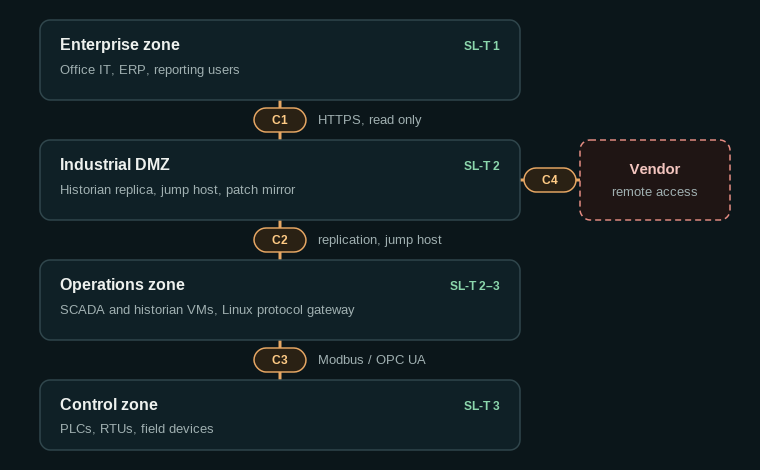
The model in brief
Put simply, a zone groups assets with common security requirements and a conduit groups the communication channels between zones. IEC 62443-3-2 describes how to split a system into zones and conduits based on a risk assessment and assign target security levels. IEC 62443-3-3 then sets system requirements. Foundational requirement FR 5, “Restricted data flow”, contains four of them:
| Requirement | Intent |
|---|---|
| SR 5.1 Network segmentation | Separate control system networks from other networks, and critical networks from the rest |
| SR 5.2 Zone boundary protection | Monitor and control communication at zone boundaries |
| SR 5.3 General purpose person-to-person communication restrictions | Keep email, chat and similar traffic away from the control system |
| SR 5.4 Application partitioning | Partition data, applications and services by criticality |
Security levels for zones and conduits
Each zone and conduit is assigned a target security level (SL-T). The levels describe the kind of attacker the zone must withstand:
| Level | Protection against |
|---|---|
| SL 1 | Casual or accidental violation |
| SL 2 | Intentional violation with simple means, low resources, generic skills and low motivation |
| SL 3 | Intentional violation with sophisticated means, moderate resources, IACS-specific skills and moderate motivation |
| SL 4 | Intentional violation with sophisticated means, extended resources, IACS-specific skills and high motivation |
Two more terms come up in assessments. SL-C is the capability security level a component or system can reach when properly configured. SL-A is the level actually achieved in operation. The gap between SL-T and SL-A is what the conduit controls and compensating measures have to close.
A worked example
The diagram above, written down as a model. The security levels are illustrative; yours come from your own risk assessment.
| Zone | Contains | SL-T (example) |
|---|---|---|
| Enterprise | Office IT, ERP, reporting users | SL 1 |
| Industrial DMZ | Historian replica, jump host, patch and antivirus mirror | SL 2 |
| Operations | SCADA and historian VMs, engineering workstation, Linux protocol gateway | SL 2–3 |
| Control | PLCs, RTUs, field devices | SL 3 |
| Conduit | Between | Allowed flows (example) |
|---|---|---|
| C1 | Enterprise ↔ DMZ | HTTPS to the historian replica, read only |
| C2 | DMZ ↔ Operations | Historian replication outbound from Operations; RDP or SSH from the jump host to named hosts |
| C3 | Operations ↔ Control | Modbus/TCP or OPC UA from the gateway and SCADA only |
| C4 | Vendor ↔ DMZ | VPN to the jump host, time-limited, MFA, session recording |
Anything not listed in a conduit is, by definition, a violation of the model. That turns “is our segmentation working?” into a concrete check: compare observed flows with these tables.
Why mixed environments do not fit the textbook picture
The classic diagram is a Purdue-style stack with a firewall between each level. Many real sites now look more like this:
- A Linux gateway runs a Modbus or OPC UA bridge. The same host also runs a metrics agent and a vendor's remote-support tool.
- Historians, SCADA and MES run as virtual machines on a shared hypervisor cluster.
- Data pipelines and dashboards run in containers or on Kubernetes, sometimes on nodes that also carry workloads from another zone.
- Vendors need remote access that cuts across several levels.
Here a subnet stops being a reliable stand-in for a zone. Two processes on one host, or two pods on one node, can belong to zones with different security levels.
Describing zones by workload
What has worked for us is describing each zone by the identities of what runs in it:
- Processes on bare metal and VMs: host, service or systemd unit, path to the executable.
- Containers: image and container name.
- Kubernetes: namespace, workload (Deployment, StatefulSet, DaemonSet) and labels.
- Devices that cannot run software (PLCs, RTUs, appliances): their addresses, plus the Linux hosts they talk to.
A conduit then becomes a short list of allowed flows between those identities, with protocol, port and direction. That is much easier to review than a subnet-to-subnet rule.
Enforcing conduits on the host
Boundary firewalls are still essential. When zones share hosts or clusters, though, part of the enforcement has to happen on the host itself. On Linux, eBPF can control connections with process and cgroup context, and it works the same way on bare metal, in VMs and on Kubernetes nodes. Devices that cannot run an agent are protected from the Linux side of their conduit, meaning the gateway or server they communicate with.
In OT two design decisions matter a lot. First, what happens if the agent fails: does traffic keep flowing or stop? Second, how do operators remove enforcement in an emergency? Expect the operator to ask what happens to the SCADA link at three in the morning, and have an answer ready.
Showing that the model holds
IEC 62443 assessments and NIS2 supervision both look for proof that the model is effective, not merely documented:
- the approved zone and conduit model, versioned, with change approvals;
- observed flows compared with the defined conduits, where anything outside is drift;
- reachability tests between zones that must not talk directly;
- coverage, including which assets were monitored and any gaps in time.
There is a full checklist in How to prove network segmentation to NIS2 auditors.
How Ironborg relates to this
We treat a conduit as a network contract. It is learned from real traffic, reviewed and approved, then watched for drift across Linux processes, VMs, containers and Kubernetes. Enforcement and contract attestation for audit evidence are planned. None of this replaces boundary firewalls or the IEC 62443 risk assessment. It sits next to them.
Want evidence that your segmentation works?
Ironborg maps real communication across Linux, VMs, containers and Kubernetes and turns it into a network contract. Continuous attestation for NIS2, ISO 27001 and IEC 62443 audits is on the roadmap. We are in early development and looking for design partners.
Join early testing ↗This article is general information, not legal advice. NIS2 obligations apply through national transposition laws, so check what applies to your organisation with your legal or compliance team.